

27° 10′ S, 153° 24′ E
Forged in disaster zones. Shaped in boardrooms.
One disaster. Two perspectives on leadership under pressure.
Lisa C
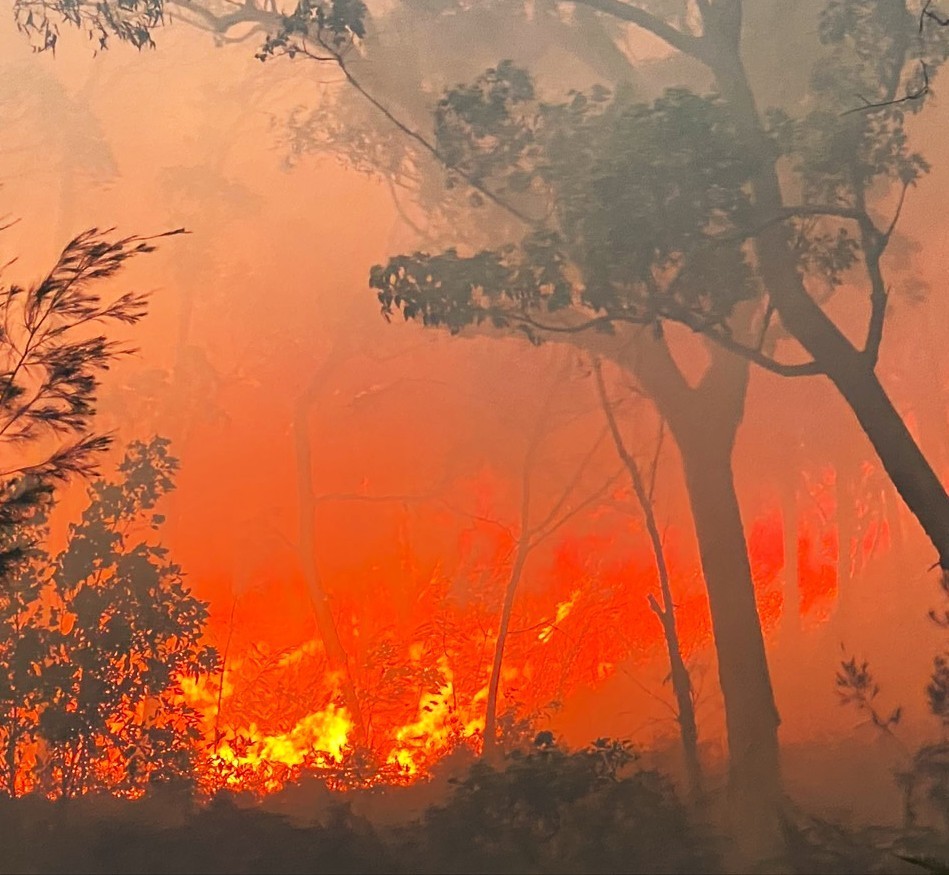
While Black Summer was still burning.
I was on Moreton Island as a volunteer firefighter when an enormous wall of flame began moving towards us.
We were halfway along a 40-kilometre sand track with nowhere obvious to go.
The crew leader beside me had considerably more firefighting experience than I did, and what I remember most was his calmness. He assessed the situation, found one of the few places where we could turn the truck around and positioned us beside the wide sand track, confident the lack of vegetation would stop the main fire front.
I trusted his judgement while remaining alert to the possibility that things might change.
The fire hit the track and immediately lost intensity.
Then embers from the canopy crossed the track and started another fire on the other side. We adapted and went back to work.
That is decision-making during a disaster. You work with the information available, draw on experience, assess risk, make the best decision you can and remain ready to change it when reality changes.
There is very little certainty and even less time to wait for it.
After Black Summer: The Royal Commission into National Natural Disaster Arrangements
Months later, I was working professionally with Queensland Fire and Emergency Services.
The flames had gone, but the decisions made before and during one of Australia's most significant natural disasters were now being examined.
It was an entirely different environment.
Instead of smoke, radios and rapidly changing weather, there were briefings, evidence, timelines, governance obligations and difficult questions. I worked with senior leaders, including preparing the Commissioner and Deputy Commissioner for the Royal Commission process.
For me, it provided a rare perspective on the same disaster.
On the fireground, decisions were being made in real time with imperfect information. Months later, those decisions could be reconstructed with documents, data and the considerable advantage of knowing what happened next.
Both perspectives matter.
Emergency leaders must be able to make decisions when they cannot possibly know everything. Strong governance requires organisations to later examine those decisions honestly, learn from them and accept accountability for what could have been done differently.
The challenge is that hindsight can make uncertainty disappear.
A decision that looks obvious when reconstructed six months later may have been anything but obvious to the person standing in smoke, receiving conflicting information and trying to anticipate what a fire would do next.
That doesn't remove accountability. It makes judgement even more important.
Two environments. Many of the same leadership capabilities.
The fireground and the boardroom are not the same, and I don't think pretending they are helps anyone.
What interests me is what survives the transition between them.
In both environments, leaders need enough confidence to make decisions and enough humility to know they may be wrong. They need courage balanced by judgement, the willingness to listen to expertise, and the adaptability to change course when the evidence changes. They also need to remain accountable for their decisions and open to having them challenged.
Underlying all of this is trust.
On Moreton Island, I followed the judgement of someone who knew more than I did.
That combination of experiences has shaped much of what I now believe about leadership.
Disaster response taught me what remains when leadership is stripped to its essentials. Boardrooms, governance and regulatory scrutiny taught me what happens when those decisions must stand up to examination afterwards.
One taught me to lead without certainty.
The other taught me that uncertainty doesn't remove accountability.
HumbleRhino sits across those two worlds.
Forged in disaster zones. Shaped in boardrooms.
Let's Talk.
Some people come to us knowing exactly what they need. Others come with a problem. Either is fine. We'd rather talk early than late.
Or email
27° 28′ S, 153° 02′ E
Brisbane, QLD
No times this monthBrisbane time (AEST)